L'Univers FOODHUB · Guide · Wagyu
Kobe or A5: One Is an Address, the Other a Grade
A5 is a carcass grade; Kobe is an appellation from Hyōgo whose marbling starts at BMS 6. What each one guarantees, why Kobe costs more, and the 4 questions to ask before you buy.

They are always mentioned together, as if they could be compared. Yet A5 and Kobe do not describe the same thing: one is a grade, awarded carcass by carcass; the other an appellation, tied to a territory. Understanding the difference means being able to read a label in ten seconds.

A5 is read on a label. Kobe is read on a map.
A5: a grade, not an origin
A5 is awarded by the Japan Meat Grading Association, an independent third-party body. The letter rates the yield (A, B or C), the number the quality (1 to 5): fifteen possible combinations, from C1 to A5.
The number takes the lowest of four criteria: marbling, meat color and brightness, firmness and texture, fat color and quality. A single weak criterion brings down the entire grade. It is very demanding, but it says nothing about the prefecture, the farm or the bloodline.

Kobe: an appellation, not a scale
Kobe is managed by the Kobe Beef Marketing & Distribution Promotion Association, under one of the strictest specifications in Japan. Among other things, a carcass must be Tajima-gyu, a Kuroge Washu bloodline born and raised in Hyōgo Prefecture; it must be a heifer or a steer, be slaughtered at one of the prefecture’s designated facilities, and show a BMS of at least 6, a quality grade of 4 or 5 and a yield grade of A or B, under a carcass weight ceiling.
The marbling threshold is worth pausing on: BMS 6 is a floor, not a peak. A Kobe beef can therefore be graded A4. The appellation guarantees an origin and a minimum level; the A5 grade guarantees the top of the quality scale. Both pieces of information are useful, and complementary.
What each one guarantees
| The question | A5 | Kobe |
|---|---|---|
| What is it? | A carcass grade | An appellation of origin |
| Who awards it? | Japan Meat Grading Association | The Kobe association |
| Does it state the origin? | No | Yes, Hyōgo |
| Marbling level | BMS 8 to 12 | BMS 6 minimum |
| Volumes | All prefectures | Around 3 000 to 5 000 head per year |
| What neither one tells you | The farm, the slaughter date, the individual ID number — unless the seller provides them | |
Why Kobe costs more
It comes down mainly to rarity: a few thousand certified animals each year, for the entire world, and very small export volumes. Add to that a long-established global reputation and the cost of policing the appellation.
At comparable marbling, a cut from Kagoshima or Hokkaidō offers a very similar experience for a noticeably lower price. This is no criticism of Kobe, whose reputation is well deserved: it is simply the equation to understand before making your choice.


The other major appellations
Kobe is not alone. Matsusaka (Mie), Omi (Shiga), Hida (Gifu), Miyazaki, Kagoshima, Saroma in Hokkaidō: the same breeds, the same national grading scale, and local specifications unique to each. Miyazaki and Kagoshima regularly top the national Wagyu competition, held every five years, where breeders go head to head.
The four questions to ask before you buy
- The 10-digit identification number. Every Japanese bovine has one. For Kobe, the association maintains a public database where it can be checked.
- The grade. A5, A4… “premium” is not a grade, it is an adjective.
- The BMS score. It accounts for most of the sensation in the mouth, more than the name of the appellation.
- The prefecture. It places the cut and, often, its style: more or less fatty, more or less fine.

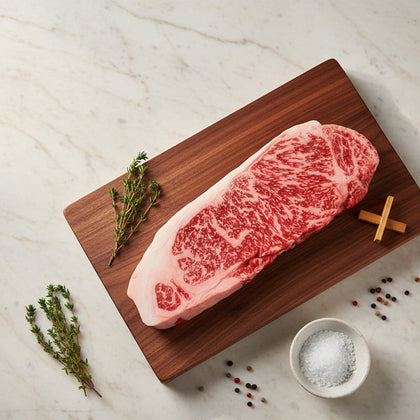
One of our Saroma cuts on arrival, with its original label.
What we offer
Our selection comes from Kagoshima, on the island of Kyūshū, and from Saroma, in Hokkaidō. A5 cuts, with their grade, a stated BMS of 8 to 12, and an identification number you can look up.
We do not offer Kobe at the moment, as export volumes are not sufficient to guarantee consistent supply. When that changes, the association’s certificate will be displayed next to the price.

Video: Japanese Wagyu butchery, by J-LEC (in English, 3 min).
Frequently asked questions
Is Kobe beef always A5?
No. The specifications require a quality grade of 4 or 5 and a yield grade of A or B: a Kobe can therefore be A4, or even B4 or B5.
Is a Kagoshima A5 as good as a Kobe?
On the quality scale, A5 is the highest level, and its marbling starts at BMS 8, whereas Kobe’s starts at 6. What Kobe adds is a strictly defined origin and a very real rarity.
Is all Wagyu Kobe?
No, it is the other way around: all Kobe is Wagyu, but Wagyu covers four breeds raised all over Japan, under dozens of regional appellations.
Can you find Kobe in France?
Yes, in limited quantities, and always with a certificate from the association. If there is none, ask for the identification number.
Further reading
- Buying authentic A5 Wagyu: the guide
- How to cook A5 Wagyu in a pan
- The traceability of our Japanese Wagyu
Our A5 cuts, with stated grade and BMS


Sources: Kobe Beef Marketing & Distribution Promotion Association, Japan Meat Grading Association, J-LEC.
Les coulisses, les arrivages et les recettes en vidéo :
@foodhubsupplyÀ lire aussi · Wagyu