L'Univers FOODHUB · Guide · Wagyu
Buying Authentic A5 Wagyu in France: The 2026 Guide
A5 grade, BMS score, official mark, identification number: how to recognize real Japanese Wagyu, choose your cut, store it and cook it.

The word "Wagyu" is everywhere; real Japanese Wagyu, far less so. Between crossbreeds raised outside Japan, vague labels and bargain-priced "Kobe" promises, it's hard to know what you're actually buying. This guide covers what to check before you pay, and how to get the most out of an exceptional cut once it's home.
The essentials in 30 seconds
- Japanese Wagyu is born and raised in Japan, and every animal carries a 10-digit identification number you can look up online.
- A5 is the highest of the 15 grades in the Japanese system: A for yield, 5 for quality.
- Marbling is measured with the BMS scale (1 to 12); an A5 falls between 8 and 12.
- A reputable seller should be able to give you the prefecture, the individual number and the grade of every cut.
What Does "Wagyu" Really Mean?
Wagyu literally means "Japanese cattle." The term covers four cattle breeds established over several generations through a pedigree registration program, as well as crosses between them:
- Kuroge Washu (Japanese Black): nearly 95 % of all Wagyu, raised throughout the country. It is the smallest-framed of the four breeds, but the one with the greatest marbling potential. When people talk about Wagyu, they almost always mean this breed.
- Akage Washu (Japanese Brown): mainly in Kumamoto and Kōchi. Light brown coat, fast growth, docile temperament.
- Nihon Tankaku (Japanese Shorthorn): in the north (Iwate, Aomori, Hokkaidō). Suited to cool climates and grazing.
- Mukaku Washu (Japanese Polled): in Yamaguchi. Now extremely rare.
Kobe, Matsusaka, Omi, Hida and Kagoshima are therefore not breeds: they are regional brands, mostly from Kuroge Washu cattle, each with its own set of specifications.
Elsewhere in the world, the word "Wagyu" is also used for animals of Japanese genetics that were born and raised in Australia, the United States or Europe, often crossed with other breeds. They are neither the same product nor the same price.
How Japanese Wagyu Is Raised
The journey is long and tightly regulated. The calf is registered at birth, with proof of its lineage and a nose print, the bovine equivalent of a fingerprint. It spends seven to ten months on a breeding farm, where calves are often bottle-fed one by one, then it is sold at auction to a fattening farmer who raises it to about 700 kg. Mother cows and pregnant cows, meanwhile, are put out to pasture so they give birth to sturdy calves.
The role of rice. Alongside hay and concentrated feed, the diet includes rice straw and whole-crop rice silage. Rice straw plays a key role in the fineness of the marbling and the very white color of the fat.
Video: J-LEC, Japan Livestock Products Export Promotion Council (in English, 3 min).
Reading the Grade: A5 and BMS
In Japan, beef is traded mainly as whole carcasses, on nearly two hundred wholesale markets. Each carcass is graded there by the Japan Meat Grading Association, a third-party body independent of both farmers and buyers, using a single national standard. The grade combines two elements, giving 15 possible grades, from C1 to A5:
- The letter (A, B or C) indicates yield: the share of saleable meat obtained from the carcass. A is above average, B average, C below.
- The number (1 to 5) indicates quality. It is assessed on four criteria: marbling; the color and brightness of the meat; its firmness and texture; and the color and luster of the fat. The final grade is the lowest of the four: three criteria scored 5 and a single one scored 1 give a carcass graded 1. An A5 must therefore excel on every count.
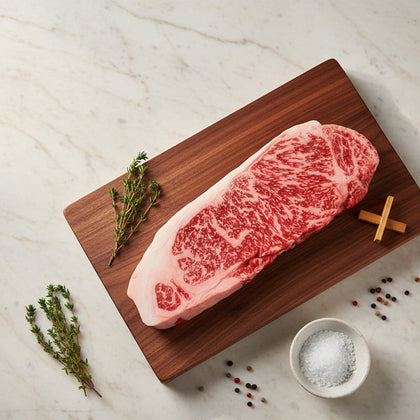
Marbling is measured separately using the BMS (Beef Marbling Standard), on a scale of 1 to 12. A5 beef corresponds to a BMS of 8 to 12. For reference, the Saroma cuts we offer are listed at BMS 8 to 12.
What Makes Wagyu Unique on the Palate
Three things define Wagyu: texture, flavor and, above all, its aroma. Japanese researchers describe a sweet, rich scent, reminiscent of coconut, that is fully released as you chew. This aroma comes through best at around 80 °C, the temperature of sukiyaki, and it stays locked in the meat, which is why Wagyu is also delicious cold.
Its fat, rich in oleic acid, melts below body temperature. The result: it literally melts on your tongue.
5 Checks Before You Buy
- The individual identification number. In Japan, all cattle wear an ear tag with a 10-digit number, and the law requires it to be recorded at every stage, right up to the sale. In the National Livestock Breeding Center's public database, this number shows, among other things, the date of birth, sex, breed, the mother's number, where and when the animal was raised, the date of slaughter or export, and the slaughterhouse. Without this number, there is no traceability.
- The grade and BMS in black and white. "Premium Wagyu" means nothing. Insist on the grade (A5, A4…) and, ideally, the BMS score.
- The prefecture or farm of origin. A serious product states where it comes from: Kagoshima, Hokkaidō, Miyazaki, and so on.
- The official Wagyu mark. Launched in 2007, the unified Japanese Wagyu logo guarantees an animal born and raised in Japan, belonging to the Wagyu breeds, and verifiable through the national traceability system.
- Appearance. Bright red meat with a fine, creamy-white, evenly spread web of fat. Thick slabs of fat or dull-looking meat should raise a red flag.
And for imports into Europe? The European Union is one of the destinations for which Japan has set specific export conditions: slaughter in an approved facility, a health certificate, and inspection by Japan's Animal Quarantine Service before departure.
At FOODHUB, every cut of Japanese Wagyu is linked to its identification number, which you can verify on our Wagyu traceability page.
Which Cut Should You Choose?
- Ribeye (entrecôte): the richest cut, with generous marbling. For lovers of melt-in-your-mouth texture.
- Striploin (sirloin): dense, even marbling and a lovely balance between fat and beefy flavor. The most versatile: steak, sukiyaki, shabu-shabu, seared nigiri.
- Tenderloin: the most tender and the rarest, with less fat. For those who find ribeye too intense.
- Lesser-known cuts (chuck, rump, top round): perfect for tataki, roasts, braises or rolls, at gentler prices.
How much? A5 Wagyu is enjoyed in small portions: allow 80 to 120 g per person as a main course, less as a tasting or a starter.
Video: Japanese Wagyu cuts, by J-LEC (in English, 3 min).
Storage and Cooking
- Keep the cut refrigerated in its vacuum pack until you're ready to cook, and observe the date on the label.
- Take it out of the refrigerator 20 to 30 minutes before cooking.
- Cut thick slices of about 1,5 to 2 cm and salt them just before cooking.
- Sear over high heat with no added fat, about 1 minute per side: the meat's own fat is enough.
- Let rest for 2 to 3 minutes, then slice thinly.
- Season simply: a good salt, a drop of artisan soy sauce or fresh wasabi.
For Japanese dishes (sukiyaki, shabu-shabu), Wagyu is sliced very thinly and cooked for a few seconds in simmering broth, where its aroma comes through best. The full pan-searing method is in our guide Cooking A5 Wagyu.
Delivery in France
Our Wagyu cuts are vacuum-packed and shipped with an unbroken cold chain. For mainland France, allow 3 to 5 business days between order and delivery (including preparation). Full details are in our shipping policy.
Frequently Asked Questions
Is Kobe the best Wagyu?
It's the most famous, not necessarily the best. Kobe is one regional brand among others; an A5 from Kagoshima or Hokkaidō can offer equivalent marbling. The difference is explained in our article A5 Wagyu vs. Kobe.
Why is A5 Wagyu so expensive?
Because it combines genetics selected over generations, long and individual rearing, a demanding grading system where a single weak criterion lowers the grade, and refrigerated shipping from Japan.
Is Australian Wagyu real Wagyu?
It comes from Japanese genetics, but it is born and raised in Australia, often crossbred. It is not Japanese Wagyu: it cannot carry the official Japanese mark or a Japanese identification number.
Can you eat Wagyu cold?
Yes. Its aroma stays in the meat after cooking and is released as you chew, even cold: tataki, sliced roast or a sandwich all suit it perfectly.
How can I verify the origin of a FOODHUB cut?
With the individual identification number linked to the cut, on our traceability page.
Go Further
- Recipe: grilled A5 Wagyu kabobs
- Kagoshima, the land of Wagyu
- Cooking A5 Wagyu: the method
- Recipe: Wagyu bowl, 3 ways
Our A5 Wagyu to Order
Two origins, two personalities: Kagoshima, on the island of Kyūshū, one of the great Kuroge Washu breeding regions, and Saroma, a certified farm in Hokkaidō. The 200 g portions are ideal for a first tasting for two.


Sources: J-LEC (Japan Livestock Products Export Promotion Council), Japan Meat Grading Association, National Livestock Breeding Center of Japan (NLBC).
Les coulisses, les arrivages et les recettes en vidéo :
@foodhubsupplyÀ lire aussi · Wagyu